Retatrutide (LY3437943): Open Questions, Published Results and the Triple-Agonist Design
Retatrutide (LY3437943) has not been approved anywhere. Metabolic researchers study it because it pairs a published mechanism and early-phase results with big unanswered questions, and its phase 3 data are still to come.
What phase 3 has to settle
Current papers keep returning to three problems. First, glucagon is meant to add energy expenditure, but large populations may eat more to compensate and cancel the gain. Second, heart rate rose at the higher doses, and what that rise means is unclear. Third, nobody yet knows how much lean mass is kept during rapid weight loss. In-vitro and preclinical groups are working on all three, and the receptor-level signaling of triple agonism is only partly mapped.
Published results, latest stage first
| Study | Finding |
|---|---|
| Phase 3, the TRIUMPH program | Running in obesity, diabetes and obstructive sleep apnea; nothing published yet |
| Liver-fat sub-study | At the top doses, over 80% of participants who started with fatty liver ended with normal liver-fat content, a result that has drawn heavy interest from hepatology |
| Phase 2, NEJM 2023 | The highest dose produced average weight loss of about 24% by week 48, still without a plateau when the study closed; side effects were mainly gastrointestinal, typical of the class |
| Phase 1 | Pharmacokinetics compatible with weekly administration, and tolerability like other incretins |
Why three receptors
The molecule is a 39-residue synthetic peptide on a GIP backbone, and a C20 fatty diacid lets it bind albumin. It switches on the GIP, GLP-1 and glucagon receptors together, but not equally: by design, GIP activity is strongest, glucagon activity moderate and GLP-1 activity attenuated, each judged against the native hormone. The thinking is that GIP and GLP-1 curb intake and improve insulin dynamics, while glucagon brings an energy-expenditure and liver fat-oxidation effect that other incretins don’t have.
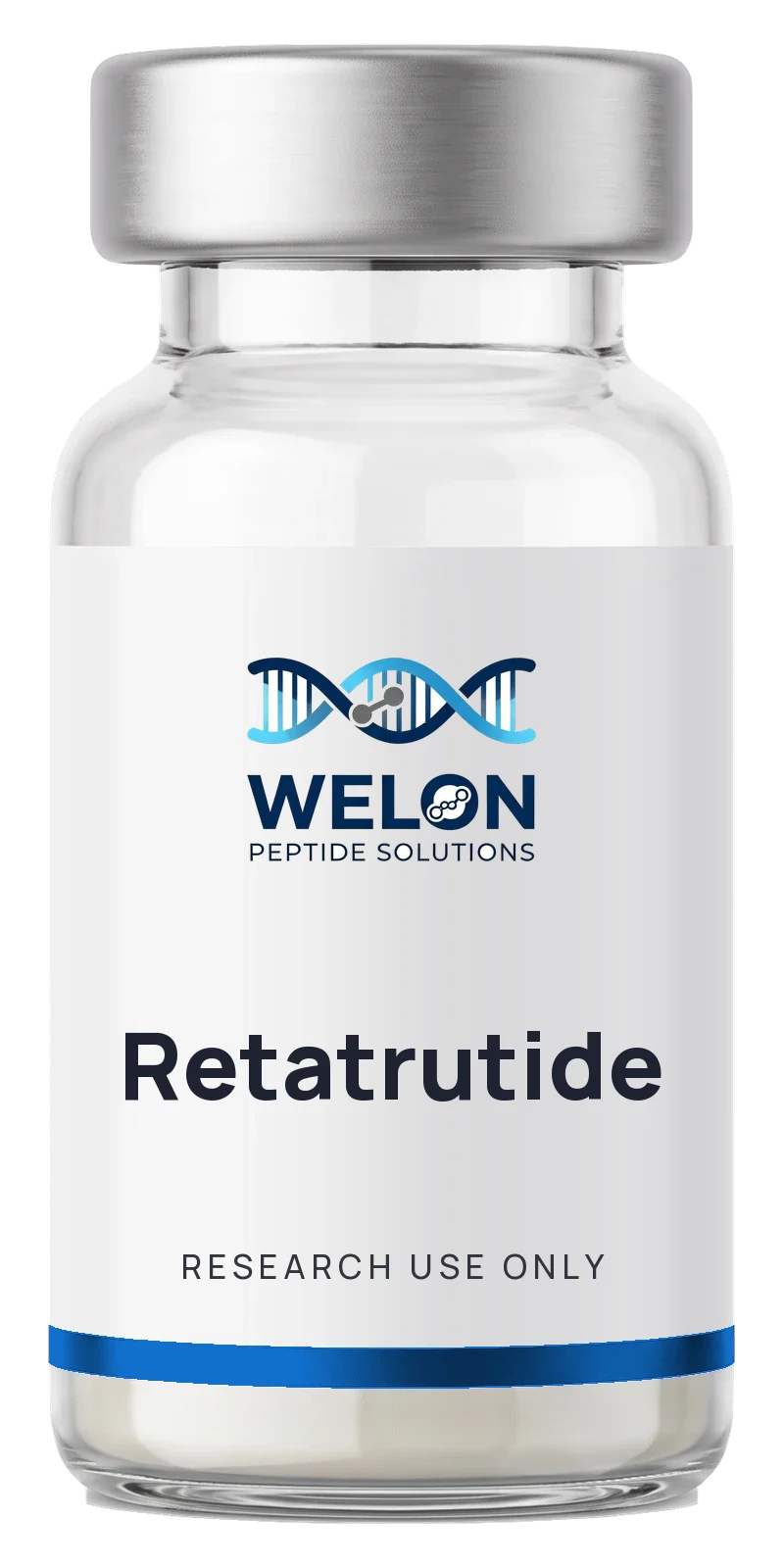
Retatrutide at Welon Peptide
Retatrutide is listed in 5mg, 10mg, 15mg, 20mg, 30mg and 60mg. A Retatrutide + Tirzepatide Blend (60mg) is listed too.
Finnrick’s passed tests of Welon Peptide Solutions retatrutide are the largest group on our COAs page: 12 of them, dated 4 Feb to 26 Jun 2026, reporting purity between 99.5% and 99.9%. Seven read 99.9%, and the lowest, 99.5%, is also the oldest (4 Feb). The page shows passed tests only; the product’s full Finnrick history can include other results, and each result applies only to the sample tested. None of the listed tests is of the blend.
Handling
As a large lipidated peptide, retatrutide needs a gentle mix in bacteriostatic water, storage at 2–8°C away from light, and no shaking or freezing once in solution (windows in how long mixed peptides last). Identity is a mass-spec question, and reading lab results explains what to look for. For dual-versus-triple designs, see tirzepatide and retatrutide compared. For research use only. Not for human or veterinary use.